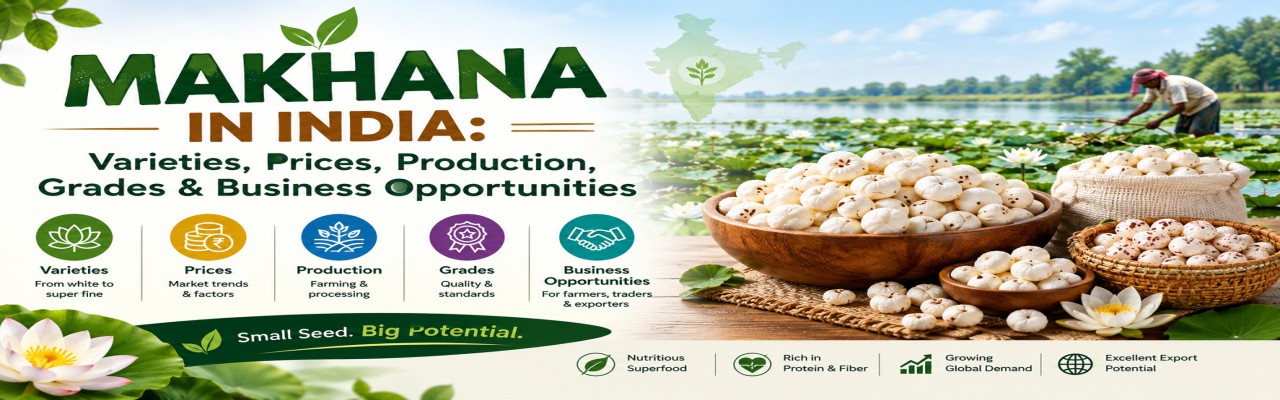
Makhana, also known as fox nuts or gorgon nuts, is one of India's most important aquatic food crops. India is the world's leading producer of makhana, with Bihar accounting for most domestic production. The crop is particularly associated with the Mithila region, where it has been cultivated and processed for generations.
Today, Indian makhana is consumed as a healthy snack and is also used by food manufacturers to make roasted snacks, flavoured makhana, sweets, breakfast products, and other food items. Growing interest in healthy and high-protein snacks has also increased opportunities for makhana manufacturers, processors, wholesalers, exporters, and bulk suppliers.
For businesses looking to source makhana from India, factors such as grade, size, colour, popping quality, moisture, packaging, processing, and order quantity can significantly affect the price.
What is Makhana?
Makhana is the edible seed of the Euryale ferox plant, an aquatic plant that grows in ponds, wetlands, and other water bodies.
The seeds are collected, dried, roasted and processed to produce the white, crunchy makhana commonly sold in Indian markets. The seeds can also be processed into different grades based on their size and quality.
Makhana is naturally gluten-free and is widely used as a snack and food ingredient. It can be eaten roasted, fried or flavoured with ingredients such as salt, spices and seasonings.
Why is Indian Makhana Popular?
Some of the reasons for the growing popularity of Indian makhana include:
-
Growing demand for healthy snacks
-
Traditional consumption in India
-
Increasing use in packaged foods
-
Availability in different grades and sizes
-
Growing domestic and international demand
-
Suitability for roasting and flavouring
-
Increasing interest from food processors and private-label brands
What Are The Different Varieties of Makhana?
Makhana can be classified in different ways. For commercial buying, size or grade is one of the most important classifications. Common market grades include:
|
Makhana Grade |
General Description |
Typical Use |
|
4 Suta |
Smaller-sized makhana |
Value-oriented products and snacks |
|
5 Suta |
Medium-small size |
Roasted and processed snacks |
|
6 Suta |
Medium-to-large size |
Retail snacks and food processing |
|
7 Suta |
Large-sized makhana |
Premium packaged products |
|
8 Suta |
Very large-sized makhana |
Premium snacks and specialty products |
The exact grading terminology and size standards can differ between suppliers and markets. Therefore, B2B buyers should request a sample and supplier-specific grading specification before placing a large order.
Which Grade of Makhana Is Best?
No single grade is best for every buyer. For premium retail snacks, larger, clean and well-popped makhana, such as 7 Suta and 8 Suta grades, can command higher prices. They are often preferred when appearance and large puff size are important.
For food processors and buyers focused on cost-effective products, 5 Suta or 6 Suta grades may be more suitable. When purchasing in bulk, buyers should evaluate:
-
Popped size
-
Uniformity
-
Whiteness and appearance
-
Broken pieces
-
Moisture level
-
Cleanliness
-
Foreign matter
-
Taste and freshness
-
Roasting/popping quality
-
Packaging
-
Laboratory testing where required
The "best" grade therefore depends on the end application and target market.
How Much Does 1 Kg of Makhana Cost?
The price of 1 kg of makhana varies considerably based on grade, size, quality, processing, packaging, and whether you buy wholesale or retail.
As an indicative market range, bulk/wholesale makhana may cost roughly ₹500 to ₹1,000+ per kg, while premium retail-grade makhana can be considerably more expensive.
Larger grades such as 7 Suta and 8 Suta generally cost more than smaller grades. A buyer should not compare prices only on a per-kilogram basis. Compare the actual grade, percentage of broken pieces, moisture, cleanliness, and usable yield.
How Much Does a 25 Kg Bag of Makhana Cost?
Using an indicative bulk range of around ₹500–₹1,000+ per kg, a 25 kg bag could cost approximately: ₹12,500–₹25,000 or more
This is only a broad reference range and should not be treated as a fixed market price.
Premium grades, larger sizes and specially processed makhana can cost more.
Transportation, GST, packaging and other commercial terms may also affect the final landed price. For a B2B purchase, buyers should request a quotation based on:
-
25 kg bag specification
-
Grade
-
Quantity of bags
-
Packaging material
-
Delivery location
-
GST
-
Freight
-
Payment terms
Is Makhana a Profitable Business?
Makhana can offer business opportunities across cultivation, processing, trading, packaging, distribution, and export.
The profitability of a makhana business depends on the business model and operating costs. For example, a processor or packaged-snack brand may have different margins than a farmer or bulk trader. Potential makhana business models include:
1. Makhana Cultivation
Farmers can cultivate makhana in suitable ponds and water bodies. Returns depend on yield, labour, cultivation costs, water conditions and market prices.
2. Makhana Processing
Raw makhana seeds require several processing stages before they become the familiar popped product. Processing can therefore create additional value.
3. Bulk Trading
Wholesalers can purchase makhana from producing regions and supply it to retailers, food manufacturers and distributors.
4. Roasted Makhana
Roasted and flavoured makhana is increasingly sold as a packaged snack. Businesses can develop flavours such as:
-
Salted
-
Masala
-
Peri-peri
-
Pudina
-
Cheese
-
Black pepper
5. Private-Label Makhana
Food businesses can source bulk makhana and sell it under their own brand after appropriate processing and packaging.
6. Export Business
Indian makhana can also be supplied to international markets where demand exists for healthy snacks and Indian food products.
However, calculate profitability after accounting for raw material cost, labour, processing, packaging, storage, transportation, marketing, wastage, taxes, and distribution expenses.
Which State Is Famous for Makhana in India?
Bihar is the state most closely associated with makhana production in India. The crop has a particularly strong presence in the Mithila region of northern Bihar, including areas such as Darbhanga, Madhubani, Purnia, Katihar, Supaul, Saharsa and surrounding districts.
Mithila Makhana has also received a Geographical Indication (GI) tag, strengthening the region's identity. Bihar's importance makes it an important sourcing destination for buyers looking for Indian makhana in bulk.
|
Rank |
State |
Importance in Makhana Production |
|
1 |
Bihar |
India's leading production hub |
|
2 |
West Bengal |
Important secondary producing state |
|
3 |
Assam |
Cultivated in suitable wetland areas |
|
4 |
Manipur |
Traditional cultivation in some areas |
|
5 |
Odisha |
Smaller-scale cultivation |
|
6 |
Uttar Pradesh |
Cultivation in selected areas |
|
7 |
Tripura |
Smaller production base |
Which State Produces the Most Makhana in India?
Bihar is India's largest makhana-producing state by a substantial margin.
The state's combination of traditional cultivation practices, suitable water bodies, established processing communities and a large supply chain has made it India's primary makhana production hub. Other states also cultivate makhana on a smaller scale, including parts of:
-
West Bengal
-
Assam
-
Odisha
-
Manipur
-
Tripura
-
Uttar Pradesh
In Which State Is Makhana the Cheapest?
No state is permanently the cheapest for makhana. Prices depend on whether you buy directly from farmers, processors, local traders, wholesalers, or retailers.
Since Bihar is India's major production centre, sourcing directly from Bihar-based producers, processors, or wholesalers can reduce intermediary and transportation costs for many buyers, particularly when purchasing in bulk.
However, the cheapest quotation is not necessarily the most economical option. Buyers should compare the delivered cost and quality. For example:
-
Product price + processing + packaging + freight + taxes = landed cost
A supplier offering a lower ex-warehouse price may become more expensive after transportation and other charges.
What Is the Current Demand for Makhana in India?
Demand for makhana in India has been increasing as consumers become more interested in convenient and healthier snack alternatives. Makhana is now sold through several channels:
-
Local grocery stores
-
Supermarkets
-
Online marketplaces
-
Dry-fruit shops
-
Health-food stores
-
Snack brands
-
Food manufacturers
-
Restaurants and cafés
-
Export businesses
The market is also expanding beyond plain makhana. Roasted, flavoured and packaged makhana have created additional opportunities for food brands.
What Factors Support Makhana Demand?
Some major demand drivers for makhana include:
-
Health-conscious consumption: Consumers increasingly want alternatives to heavily processed snacks.
-
Premium snacking: Packaged makhana can be positioned as a premium snack product.
-
Flavour innovation: Brands can develop multiple flavoured products using the same basic ingredient.
-
E-commerce: Online grocery and direct-to-consumer channels have made packaged makhana easier to sell across India.
-
Food processing: Makhana is being incorporated into different snack and food products.
-
Export opportunities: Indian makhana has also attracted attention in international markets.
-
For B2B suppliers, this creates opportunities in bulk supply, private labelling, food processing and distribution.
How Much Makhana Can Be Produced in 1 Acre?
Makhana yield from one acre can vary considerably depending on the cultivation system, pond conditions, variety, management practices, labour and harvesting methods.
A broad indicative figure often used for commercial planning is around 1,000–1,500 kg of raw makhana seed per acre, although actual results can be lower or higher. Importantly, raw seed yield should not be confused with the quantity of finished popped makhana. The final quantity of saleable popped makhana depends on:
-
Seed quality
-
Processing method
-
Popping efficiency
-
Moisture
-
Broken seeds
-
Processing losses
-
Grade requirements
Farmers and investors should therefore calculate profitability using actual local production and processing data rather than relying solely on a standard yield estimate.
Why is Makhana So Costly?
Makhana is relatively expensive compared with many conventional snack ingredients because its production and processing involve several labour-intensive stages.
1. Water-Based Cultivation
Makhana is generally cultivated in ponds and water bodies, unlike ordinary field crops.
2. Labour-Intensive Harvesting
Collecting makhana seeds from water can require significant manual effort.
3. Processing Requires Multiple Steps
The harvested seeds need to be dried, graded, roasted, and popped before becoming the white makhana commonly sold to consumers.
4. Popping Requires Skill
Achieving good-quality, large and properly popped makhana requires suitable processing techniques.
5. Premium Grades Are Limited
Large, clean and uniformly popped makhana generally attracts higher prices.
6. Growing Consumer Demand
Increasing demand for packaged and healthy snacks can support higher prices for quality makhana.
7. Supply-Chain Costs
Transportation, storage, packaging, processing and distribution add to the final selling price.
As a result, the retail price of finished makhana can be significantly higher than the farm-level price of raw seeds. Makhana supply chain in India. The Indian makhana industry involves several stages:
Cultivation → Harvesting → Drying → Seed Processing → Grading → Roasting/Popping → Packaging → Wholesale → Retail/Export
Different businesses participate at different stages.
-
Farmers produce raw makhana seeds.
-
Processors convert harvested seeds into marketable popped makhana.
-
Wholesalers purchase makhana in larger quantities and supply retailers, food businesses and distributors.
-
Manufacturers use makhana to produce packaged and flavoured snacks.
-
Exporters source, process, and package makhana to meet overseas market requirements.
This creates opportunities for B2B buyers and sellers across the supply chain.
Makhana Business Opportunities in India
|
Business Type |
Opportunity |
|
Farmers |
Makhana cultivation |
|
Processors |
Seed processing and popping |
|
Wholesalers |
Bulk distribution |
|
Food manufacturers |
Makhana-based snacks |
|
Retail brands |
Packaged makhana |
|
Private-label companies |
Branded makhana products |
|
Exporters |
International supply |
|
Distributors |
Regional distribution |
Conclusion
Makhana has developed from a traditional regional food into an important Indian agricultural and food-processing product. Bihar remains the country's leading makhana-producing state, with the Mithila region playing a particularly important role in cultivation and processing.
For buyers, makhana is available in different sizes and grades, with larger and well-popped grades generally commanding premium prices. Bulk prices can vary substantially depending on grade, quality, quantity, processing and delivery location. For businesses entering the makhana industry, opportunities exist in cultivation, processing, wholesale trading, packaged snacks, private labelling and exports.