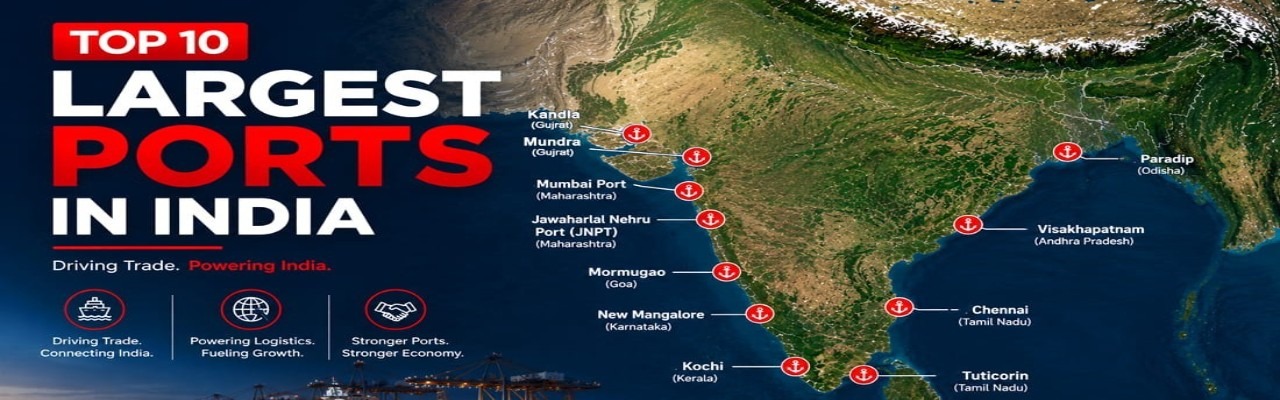
India has one of the longest coastlines in the world and is heavily dependent on maritime trade. Nearly 95% of the country’s merchandise trade by volume passes through its ports, making them a vital part of the Indian economy.
India has 13 major ports administered by the Government of India through the Ministry of Ports, Shipping and Waterways.
And all the ports in India are situated in 9 coastal states, including Goa, Karnataka, Kerala, West Bengal, Gujarat, Tamil Nadu, Andhra Pradesh, and Odisha.
From crude oil and coal to automobiles and containers, Indian ports facilitate the movement of goods that support industries and international commerce.
In FY 2025-2026, India’s major ports collectively handled 915.17 million tonnes (MT) of cargo, exceeding the annual limit. This blog ranks the top 10 largest ports in India by cargo-handling capacity and strategic importance.
Quick Overview of the Largest Ports in India
|
Rank |
Port |
State |
Coast |
Main Cargo |
|
1 |
Deendayal Port (Kandla) |
Gujarat |
West Coast |
Petroleum, Containers, Fertilizers |
|
2 |
Paradip Port |
Odisha |
East Coast |
Coal, Crude Oil, Iron Ore |
|
3 |
Jawaharlal Nehru Port (JNPA/Nhava Sheva) |
Maharashtra |
West Coast |
Containers |
|
4 |
Visakhapatnam Port |
Andhra Pradesh |
East Coast |
Iron Ore, Coal, Petroleum |
|
5 |
Mumbai Port |
Maharashtra |
West Coast |
Petroleum, Bulk Cargo |
|
6 |
Chennai Port |
Tamil Nadu |
East Coast |
Containers, Automobiles |
|
7 |
V.O. Chidambaranar Port (Tuticorin) |
Tamil Nadu |
East Coast |
Coal, Containers |
|
8 |
Mormugao Port |
Goa |
West Coast |
Iron Ore, Coal |
|
9 |
New Mangalore Port |
Karnataka |
West Coast |
Petroleum, Fertilizers |
|
10 |
Cochin Port |
Kerala |
West Coast |
Containers, Petroleum, and LNG |
How are India’s Largest Ports Ranked?
The top 10 largest ports in India are ranked based on factors such as annual cargo traffic, their strategic location, container throughput, available infrastructure, and connectivity. Here is the brief explanation of each of these points:
Annual Cargo Traffic
-
The most important ranking factor is the total cargo volume handled annually, measured in million metric tonnes (MMT).
-
Ports that process larger quantities of goods, including coal, crude oil, containers, iron ore, and fertilizer, are generally ranked higher.
-
The figures of the annual cargo traffic are from the Ministry of Ports, Shipping and Waterways, and the Indian Ports Association (IPA)
Container Throughput
-
Container ports are also assessed by the number of Twenty-foot Equivalent Units (TEUs) they handle annually.
-
A higher TEU count indicates greater efficiency in handling containerized cargo and stronger connectivity with global shipping networks.
-
Jawaharlal Nehru Port (JNPA) is India’s leading container port because it handles the highest volume of container traffic.
Port Infrastructure and Capacity
The infrastructure and capacity of the port also influence the port’s operational efficiency. For example, ports with deep-water berths, multiple cargo terminals, mechanized handling equipment, large storage facilities, and advanced logistics systems can accommodate larger vessels and process cargo more quickly, thereby increasing their overall capability.
Strategic Location
-
A port’s geographic location also affects its importance in international and national trade.
-
There are more than 200 ports in India, but only a few are considered significant due to their geographical locations.
-
Moreover, ports located near industrial hubs, manufacturing units, mining regions, and major shipping routes often handle more cargo due to easier access for exporters and importers.

Top 10 Largest Ports in India
Based on the factors mentioned above, the list of the top 10 largest ports in India is as follows:
1. Deendayal Port (Kandla), Gujarat
Deendayal Port, formerly known as Kandla, is one of the largest ports in India by cargo-handling capacity. This port is a major gateway for trade with the Middle East, Europe, and Africa.
In FY 2025-2026, the Deendayal Port Authority was the top performer with 160.11 MT of cargo shipments.
Key highlights are:
-
Location: Kutch, Gujarat
-
Establishment: 1950
-
Main cargo: Petroleum products, fertilizers, coal, containers
-
Why it is important: Deendayal Port is India’s largest port by cargo traffic and a key trade hub on the west coast.
2. Paradip Port, Odisha
Situated on India’s east coast, Paradip Port is a leading bulk cargo port. It primarily handles coal, iron ore, crude oil, and thermal coal used by power plants and the steel industry.
Paradip Port is located near the mineral-rich eastern states of India, such as Odisha, Jharkhand, and Chhattisgarh, making it an essential gateway for imports and exports. Paradip Port ranked 2nd in cargo shipments in FY 2025-2026, with 156.45 MT.
Key highlights:
-
Location: Odisha
-
Establishment: 1966
-
Main Cargo: Coal, iron ore, crude oil, fertilizer
-
Why it is important: One of India’s largest bulk cargo ports supports the steel and energy industries.
3. Jawaharlal Nehru Port (JNPA)
Also known as Nhava Sheva Port, Jawaharlal Nehru Port Authority (JNPA) is India’s largest container port.
JNPA has multiple container terminals and advanced logistics infrastructure that connect India to major global shipping routes.
Key highlights:
-
Location: Navi Mumbai, Maharashtra
-
Establishment: 1989
-
Main Cargo: Containers
-
Why it is important: India’s busiest container port and a key hub for international trade.
4. Visakhapatnam Port, Andhra Pradesh
Visakhapatnam Port is one of India’s oldest natural harbors and among the country’s most important ports on the east coast.
The port plays an important role in supporting industries across eastern and central India. Here are the key highlights of Visakhapatnam Port:
-
Location: Andhra Pradesh
-
Establishment: 1933
-
Main Cargo: Containers, Iron ore, petroleum, coal
-
Why it is important: A natural deep-water harbor with excellent connectivity to industrial regions.
5. Mumbai Port
Mumbai Port is one of India’s oldest ports. It has been the cornerstone of India’s maritime trade for over a century, with specialization in handling liquid cargo such as crude oil and petroleum products. The port also serves cruise ships and coastal shipping services. Key highlights:
-
Location: Mumbai, Maharashtra
-
Establishment: 1873
-
Main Cargo: Chemicals, Petroleum products, and bulk cargo
-
Why it is important: A historic port supporting western India’s trade and energy imports.

6. Chennai Port
Chennai Port is one of the largest ports in South India. Often nicknamed the “Detroit of India”, the Chennai port is important for India’s automobile exports. Key highlights:
-
Location: Chennai, Tamil Nadu
-
Establishment: 1881
-
Main Cargo: Automobiles, containers, machinery, and general cargo
-
Why it is important: A leading export hub for vehicles and manufactured goods.
7. V.O. Chindambaranar (Tuticorin) Port
Formerly known as the Tuticorin Port, V.O. Chindambaranar Port is one of India’s fastest-growing ports. This port acts as a major gateway for trade with Sri Lanka, Southeast Asia, and the Far East.
The key highlights are as follows:
-
Location: Thoothukudi, Tamil Nadu
-
Establishment: 1974
-
Main Cargo: Coal, containers, and fertilizers
-
Why it is important: A strategic deep-water port supporting Southern India’s exports.
8. Mormugao Port, Goa
Mormugao Port, located on the west coast of India, has historically been one of India’s largest exporters of iron ore. And over the past many years, its cargo mix has diversified. Now Mormugao Port supports Goa’s mining and industrial sectors. In fact, in FY 2025-2026, Mormugao Port Authority recorded the highest growth, with an increase of 15.91%.
-
Location: Goa
-
Establishment: 1888
-
Main Cargo: Iron ore, coal, petroleum products
-
Why it is important: A major West Coast port with strong mineral export capabilities.
9. New Mangalore Port
New Mangalore Port is Karnataka's only major port and serves industries across the state. It handles crude oil, petroleum products, fertilizers, coal, edible oils, and container cargo. The port also supports imports for nearby refineries and fertilizer plants. Here are some of the important points about this port:
-
Location: Karnataka
-
Establishment: 1974
-
Main Cargo: Petroleum products, coal, fertilizers
-
Why it is important: A key logistics hub for Karnataka’s industrial and energy industries.
10. Cochin Port, Kerala
Located on the Southwest coast, Cochin Port is an important gateway for trade with the Middle East and European countries. Cochin Port is also home to the International Container Transshipment Terminal (ICTT) at Vallarpadam, which is India’s first dedicated transshipment terminal.
-
Location: Kerala
-
Establishment: 1928
-
Main Cargo: Petroleum, LNG, petroleum products, containers, and spices
-
Why it is important: A strategically located port supporting international trade and transshipment operations.
Major Ports vs. Non-Major Ports in India
India has both major and non-major ports. Major ports are maintained by the Government of India under its Ministry of Ports, Shipping and Waterways. Non-major ports come under state governments or state maritime boards.
|
Major Ports |
Non-Major Ports |
|
Managed by the Central Governments |
Managed by State Governments |
|
Handle larger cargo volumes |
Regional trade |
|
International shipping routes |
Coastal shipping |
|
Better infrastructure |
Smaller capacity |
Which is the Largest Port in India?
The largest port in India, according to the latest figures from the Ministry of Ports, Shipping, and Waterways, is divided into several categories. The sustained growth in cargo handling and maritime trade in India was seen across ports in different regions.
-
By total cargo handled: Deendayal Port (Kandla) emerged as the top-performing port at 160.11 MT.
-
By container traffic: Jawaharlal Nehru Port Authority (JNPA) is India's largest container port and handles the highest volume of containerized cargo, measured in TEUs.
Here are the key highlights of India’s major port performance FY 2025-2026:
|
Performance Indicator |
FY 2025-2026 Highlights |
|
Total Cargo-Handled |
915.17 million tonnes (MT) |
|
Top Cargo-Handling Port |
Deendayal Port Authority- 160.11 MT |
|
Second-Largest Port |
Paradip Port Authority- 156.45 MT |
|
Third-Largest Port |
Jawaharlal Nehru Port Authority (JNPA)- 102.1 MT |
|
Other High-Performing Ports |
Visakhapatnam Port Authority, Mumbai Port Authority, Chennai Port Authority, and New Mangalore Port Authority |
Government Initiatives to Modernize Indian Ports
The Government of India has launched several initiatives to modernize Indian ports and strengthen the country’s maritime sector. These programs aim to increase cargo-handling capacity, improve logistics efficiency, and promote sustainable development. The record performance in FY 2025-2026 reflects growing trade volumes and the effectiveness of these government initiatives.
-
The Ministry of Ports, Shipping and Waterways launched the Sagarmala Program in 2015. This program focuses on modernizing existing ports, developing new ports, enhancing cargo handling capacity, and improving port connectivity.
-
PM Gati Shakti National Master Plan is a national infrastructure initiative designed to integrate transportation networks nationwide.
-
India is continuously working on port digitization. Recently, the GOI launched two portals, the National Logistics Portal (Marine) and the Maritime Single Window, for unified trade facilitation.
-
SAROD-Ports (Society for Affordable Redressal of Disputes - Ports), a dispute-resolution portal, is also part of this modernization initiative.
Future of India’s Ports Infrastructure
-
Currently, the Indian government is modernizing its ports under the Maritime India Vision 2030 and Maritime Amrit Kaal Vision 2047.
-
India is building world-class ports, strengthening logistics, enhancing global competitiveness, and positioning itself as a leading maritime nation. Ministry of Ports, Shipping and Waterways continues to advance a comprehensive maritime strategy focused on port-led development and sustainability.
-
The Government of India enacted the Major Port Authorities Act, 2021, replacing the Major Ports Trusts Act, 1963.
-
The government is also integrating maritime services through digital platforms such as Sagar-Setu and e-Samudra to simply documentation, approvals, and trade facilitation.
-
The future of Indian ports lies in becoming smart ports that use advanced technologies to improve operational efficiency.
-
Environmental sustainability is also becoming a priority of India’s maritime industry. As part of the GOI, the green initiatives focus on renewable energy, cleaner fuel, waste management, and pollution control.
Conclusion
India’s ports are the backbone of the country’s international trade and logistics networks. From Deendayal Port to Paradip Port to JNPA to Visakhapatnam Port, these maritime gateways handle millions of tonnes of cargo every year and support industries across the country.
With continued government support under initiatives such as Sagarmala, PM Gati Shakti, and the Maritime Amrit Kaal Vision 2047. These developments are expected to strengthen India’s position as one of the world’s leading maritime and logistics hubs over the coming decades.